- Psychedelics Uncensored
- Posts
- 🚀 The 5-MeO-DMT Experience
🚀 The 5-MeO-DMT Experience
Inside the “everything and nothing” state: what 5-MeO-DMT does to experience, and what Imperial College London is finding in the brain.

🌟 A Fast Exit From “You”
Imagine sitting in a quiet room, eyes closed, pipe in hand. You inhale, hold, exhale.
For a second, everything feels normal. Then the onset hits… fast, mechanical, undeniable. The body feels like it is crumbling or stretching. The room seems to fracture, expand, and collapse in on itself. Thought accelerates and slips its rails. Every familiar anchor begins to move at once.
Very quickly, the usual center of gravity, “me, in here, looking out at the world,” starts to loosen.
At first it can feel like soft erosion: the edges of the body become fuzzy, thoughts lose their grip, and emotions show up as raw currents of energy. Then, in many cases, the whole frame flips. The sense of being a separate subject inside experience gives way to a feeling of being the experience itself. There is sound, light, feeling… but no clear owner of any of it.
For a lot of people, that shift arrives as an encounter with a pure white presence. Not a spotlight in front of you, not a tunnel in the distance, but a field of bright, living awareness that stretches in every direction and includes everything.
The “room” drops out. Orientation drops out. What remains feels like one continuous thing, luminous, intelligent, and already complete. Many describe it as merging with God, source, or the universe, yet the core recognition often lands even simpler: “this is what I am.”
Inside that oneness, the normal boundaries fall away one after another:
The line between self and world softens, then disappears.
Time feels irrelevant, like a concept that belonged to somewhere else.
Space stops dividing into “here” and “there”; everything sits inside the same undivided field.
What replaces those boundaries is a combination people struggle to describe: limitless, yet intimate. The love often feels universal and personal at the same time, as if the entire cosmos leans in and says, “you were never separate in the first place.”
For some, the journey stays within that white, heart-splitting radiance, overwhelming yet still dimly recognizable as “happening to someone.” For others, 5-MeO-DMT pushes further into an even more abstract zone. The body map disappears. Inner speech goes silent. What remains can feel like naked awareness moving through subtle patterns, hints of geometry, movements, or fields of light that barely register as visuals, with no clear location and no narrative self watching.
In a smaller subset of cases, the trajectory reaches a near-total “everything / nothing” state. No room, no body, no time, no inner commentator, no subject and object, yet awareness persists as a quiet, vast, undeniably present wholeness. From the outside it can look like someone has simply gone under. From the inside, it can feel like being more awake than ever, in a state with almost no content at all.
Then the mind reorients. Sounds return, then a vague sense of weight in the shoulders, then the recognition of a room, other people, and finally a coherent “me” again. What follows is often a calm afterglow: less mental noise, more space, emotional release, and a stretched, meditative clarity that can linger for hours or days.
All of that can unfold in under thirty minutes, which is exactly why 5-MeO-DMT, often nicknamed the “God molecule,” has drawn so much attention from researchers trying to understand how the sense of self can dissolve, contact something that sometimes feels sacred, and then knit itself back together.
We sat down with the researchers behind Imperial College London’s latest work with 5-MeO-DMT, who walked us through two remarkable studies: a placebo-controlled neuroimaging study of 36 participants, and a one-of-a-kind experiment with a Lama who has logged more than 54,000 hours of advanced meditation.
This may be some of the most fascinating psychedelic research you’ve ever read. Let’s jump in.
🧠 5-MeO vs DMT: The Other “God Molecule”
Before we get to the lab, it helps to zoom out and clear up a common confusion.
5-MeO-DMT (5-methoxy-N,N-dimethyltryptamine) is not the same thing as N,N-DMT, the classic “breakthrough” compound behind many hyperspace and “machine elf” stories. Chemically, they sit in the same family. Phenomenologically, they often feel like opposites.
N,N-DMT tends to explode outward: hyper-saturated geometry, alien architectures, entities, complex scenes, a sense of being hurled into another world full of content.
5-MeO-DMT tends to implode inward: the visual complexity collapses into undifferentiated presence — often white, often content-light — with the emphasis on what you are rather than what you see.
Both can dismantle the usual sense of self. But where N,N-DMT often feels like stepping into a different universe, 5-MeO-DMT feels more like stepping out of the entire “universe” frame and into a bare, luminous ground.
Pharmacologically, 5-MeO-DMT is one of the most potent naturally occurring psychedelics we know. It appears in several plant species and in the venom of the Bufo alvarius (Sonoran Desert) toad, and it can also be produced synthetically. When inhaled, it acts in seconds and resolves in well under an hour.
Traditionally, 5-MeO-DMT has appeared in ritual and underground settings. In the past decade, it has also begun to surface in clinical and psychotherapeutic contexts. At Imperial College London, researchers like Dr. Chris Timmermann have been drawn to it for a specific reason: it collapses the self-model fast enough to study consciousness in motion, not just in hindsight.

Dr. Chris Timmermann, Neuroscientist and Psychologist, Imperial College London
Timmermann came up through Imperial’s psychedelic research world, earning his PhD there in 2020, then leading the DMT Research Group, and he now co-directs UCL’s Centre for Consciousness Research, where the work centers on comparing two routes into self-loss: psychedelics and meditation.
👤 The Self as a Glitchy Narrator
One of the big ideas behind this work comes from contemporary neuroscience: the self is a process, not a thing.
Moment to moment, the brain weaves together sensations, memories, predictions, and social cues into a running narrative that feels like “me.” That process, often called the self-model, tends to involve a particular constellation of brain regions known as the default mode network (DMN). This network ramps up when we introspect, daydream, or think about our past and future.
A healthy DMN helps us remember who we are, navigate social life, and plan ahead. It can also trap people in rigid loops: depression, shame, trauma narratives, obsessive self-critique. If the self is a story, some stories turn into cages.
When 5-MeO-DMT enters the system and pulls that story apart in seconds, it creates something rare: a chance to watch the construction and deconstruction of self in real time. What happens to the DMN, to conscious awareness, to the basic sense of “I am here” when the white presence rolls in and the ego goes offline? That’s the question Imperial set out to address head-on.
📡 Filming Ego Dissolution in the Lab
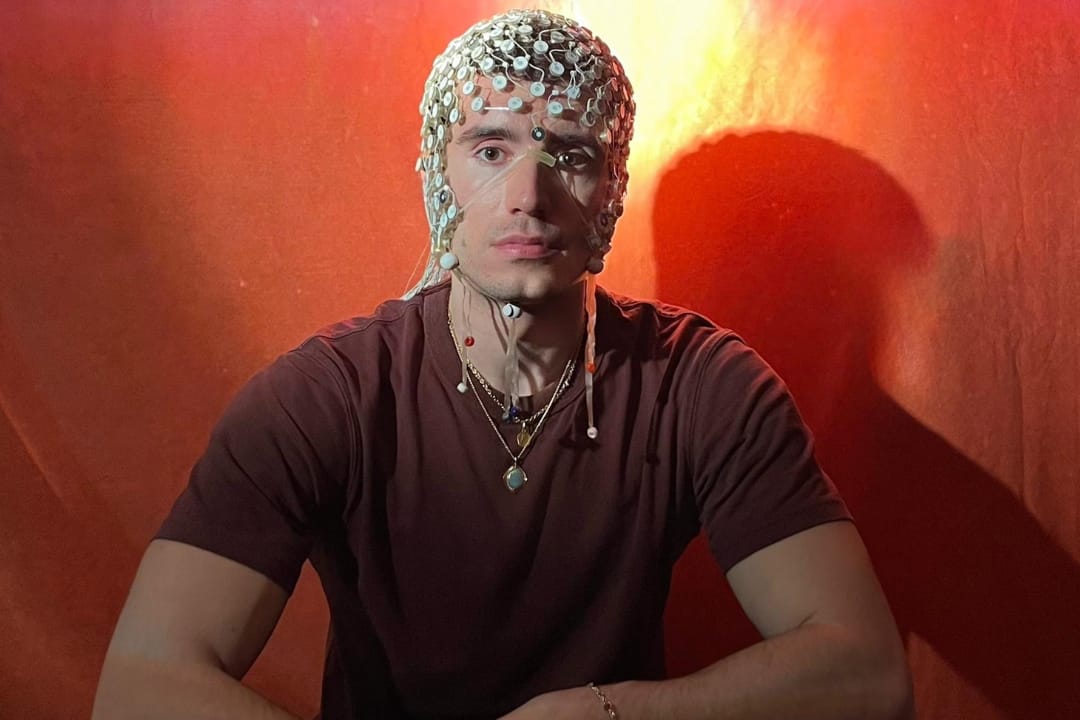
Tommaso Barba, Psychedelic Neuroscientist, Imperial College London
In their larger study, Dr. Chris Timmermann, Tommaso Barba, James Sanders, and the team at Imperial ran more than 70 sessions with 36 participants, including carefully designed placebo controls.
This time, they didn’t just administer 5-MeO-DMT and ask people how it felt afterward. While participants lay in the lab, the team recorded high-density brain activity and collected live ratings of ego dissolution, moment-by-moment reports tracking how strongly the sense of self was fading, disappearing, or returning.
Earlier work had already suggested that 5-MeO-DMT suppresses alpha and beta rhythms associated with self-referential thought, bodily boundaries, and internal narration. What this study added was precision. By time-locking subjective experience to neural data, the team could begin mapping not just that ego dissolution occurs, but how it unfolds.
Which brain rhythms mark the exact moment the “I” drops out?
Does the self return gradually or snap back into place?
Do different people arrive at similar “everything / nothing” states through different neural routes?
Data collection is complete. Analysis is underway. The goal is ambitious: sketch an early map of how awareness reorganizes as the sense of self dissolves and reassembles under extreme conditions.
🧘♂️ A Lama, 54,000 Hours, and One Dose
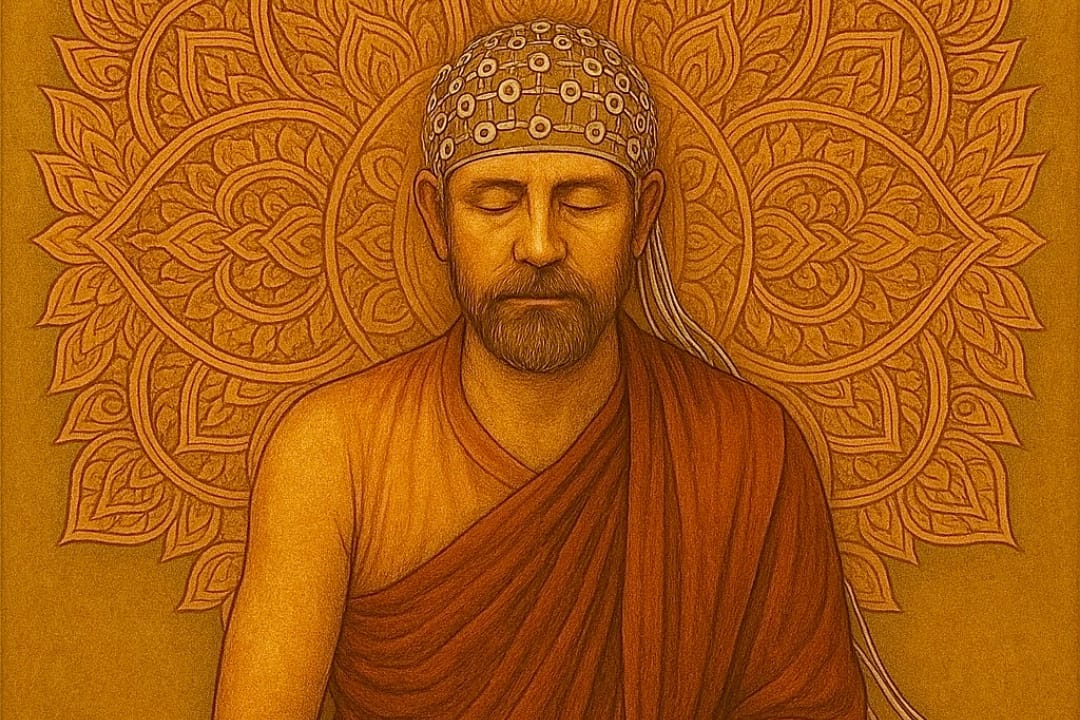
If that were the whole story, it would already be significant. But Dr. Timmermann also designed a very different kind of experiment, one that reads like a thought experiment brought to life, and his team at Imperial College London carried it out.
A Lama with over 15 years of intensive practice and more than 54,000 hours of meditation agreed to enter the lab. His training centered on nondual meditation — a practice where awareness rests without a clear boundary between subject and object.
Using a protocol designed by Dr. Timmermann, the study was built to place meditation and 5-MeO-DMT on equal footing. The Lama was assessed under three conditions, all while his brain activity was recorded with high-density EEG and his experience tracked in detail:
Resting in nondual meditation
Receiving a low dose of 5-MeO-DMT
Receiving a high dose of 5-MeO-DMT
Across all three, the sense of “me” softened, but in very different ways.
Nondual meditation brought clarity and equanimity. The world remained present, but felt less divided.
The low dose introduced imagery and emotional movement, along with a lighter, quieter sense of self, similar to meditation, but with a different texture.
The high dose removed body and environment entirely, leaving only a bright, empty awareness with no observer.
On paper, all three involved ego loss. The path into that state, however, turned out to matter a great deal.
You can read the full preprint here for more information.
🧭 Two Ways to Vanish
When the team dug into the data, a surprising pattern emerged. There might be at least two distinct routes to ego loss.
1. The subtractive route
In this path, thoughts quiet progressively. The world stays visible and coherent, but it stops feeling separate. Awareness opens up, yet the sensory field remains continuous with the body and environment.
This appeared during nondual meditation and the low dose of 5-MeO-DMT. Brain-wise, both showed:
Increased alpha activity (linked to calm, focused attention)
Decreased gamma activity (often associated with intense sensory firing and complex processing)
The brain, in simple terms, became quieter and more stable while the sense of self softened and spread out — a kind of gentle oneness, where you remain aware of the world, but the world and “you” feel like the same thing.
2. The saturation route
The high-dose 5-MeO-DMT session looked very different.
Here, the system did not simply quiet down. Instead, sensory input seemed to dissolve into a flood of intensity. The environment and body dropped away. Internal experience surged, fast and overpowering — closer to that all-consuming white presence and “everything / nothing” we started with.
On the EEG, this showed up as:
Increased gamma activity
Higher neural entropy — a more chaotic, less predictable brain signal
Same outcome on the surface — “no me” — but almost the opposite mechanism: one path empties the stage; the other overwhelms it.
🤖 When AI Meets No-Self
To push this comparison further, the team trained an AI model on the Lama’s brain activity during nondual meditation. The question was simple: if the AI learned to recognize that meditative “no-self” state, what would it say about the 5-MeO sessions?
The answer was striking:
The AI recognized the low-dose 5-MeO-DMT state as comparable to the meditative state.
It did not recognize the high-dose 5-MeO-DMT state as the same thing at all.
Under the hood, the overlap seemed to hinge on a shared reduction in gamma activity in specific, especially posterior brain regions. The meditative and low-dose states both involved a quieter, more ordered brain that still stayed in touch with the environment, even as the sense of “me” loosened.
The high dose, meanwhile, pushed the brain into a very different regime: high intensity, high entropy, and a total break from the usual sensory frame. Same Lama, three states, one lab — and at least two very different signatures of ego loss.
🔬 Why Any of This Matters
For decades, spiritual traditions and psychedelic explorers have used similar language to describe certain states: ego death, unity, nonduality, oneness, pure awareness. From the outside, it is easy to file all of that under one category and move on.
Imperial’s work suggests a more nuanced picture.
Meditation and 5-MeO-DMT can both reduce the sense of self — and in some cases, they may converge on similar neural patterns. At other times, especially at higher doses, 5-MeO-DMT may push consciousness into states that differ both in feel and in brain dynamics from even very advanced meditation.
That matters for several reasons:
For science, it offers a framework to study consciousness more precisely. “Ego dissolution” stops being one big bucket and becomes a family of related but distinct states, each with its own neural signature.
For therapy, it raises careful questions about dose, preparation, and intention. A subtractive, meditation-like softening of self may differ in impact and integration from a saturated, world-erasing blast into the absolute, even if both feel like oneness.
For spirituality, it opens a bridge between contemplative traditions and laboratory neuroscience: two different toolkits circling the same mystery from different angles.
🌱 After the White Light
The self looks less like a fixed entity and more like a set of adjustable parameters, attention, body awareness, narrative, emotional tone that can be tuned in different ways. Meditation tunes them gradually from the inside out. 5-MeO-DMT yanks them in seconds. Sometimes they land in similar places. Sometimes they don’t.
A harm-reduction note matters here, too. 5-MeO-DMT can be one of the strongest psychedelic experiences and can potentially induce long-term effects if not integrated well. It can bring up strong feelings of vulnerability, feeling ‘raw’ etc, that sometimes last long after the acute effects are gone. This isn’t for everyone, and careful screening, preparation, a safe setting, and real integration support make a difference. Do your research before blindly jumping in.
Imperial’s work with 5-MeO-DMT is still in motion. The big placebo-controlled study has finished data collection, with results expected after analysis wraps up. The Lama case study is awaiting peer review. These are early days. But they already hint at a future where discussions of “ego death” become less vague metaphor and more mapped territory.
For now, we are left with a simple, wild fact:
A person can sit in a lab, hooked up to electrodes, surrounded by researchers, and travel into a state with no body, no story, no name, while their brain quietly hums away on the monitor. Years of meditation can lead there. A few milligrams of vaporized 5-MeO-DMT can do it too, through a different door.
Somewhere between those routes, and in the differences between them, a clearer picture of consciousness is starting to emerge. And thanks to teams like Timmermann, Barba, Sanders, and their collaborators, we are one step closer to understanding what it really means when the “I” disappears… and something deeper remains.

✅ No one can stop you from seeing what’s delivered directly to your email.
You’re already subscribed - congratulations!
You beat the algorithm 😉
Thank you for joining us as we continue to navigate this ever-changing landscape.
P.S. Explore what they don’t want you to see - check us out on X (Twitter) and Instagram, and dive deeper into all things psychedelic on our website. 🌐✨